What Are the Formulas for Virality in Social Media? (Part 1)

An attainable opportunity appeal may encourage sharing when it connects a recognizable desire to a credible route, explains the possibility clearly, and offers value to a recipient, but its effects must be tested separately from clicks and reach. Summary
Three likes. Then, four years later, roughly 2,400 likes and 549,000 views.
The comparison in The Amanah Vault puts two posts about an online solitaire business beside each other. The first announces an interview: a game has become a $1.5K-a-month side hustle. The second opens with a possibility: “A simple website with a good domain name could replace your salary.”
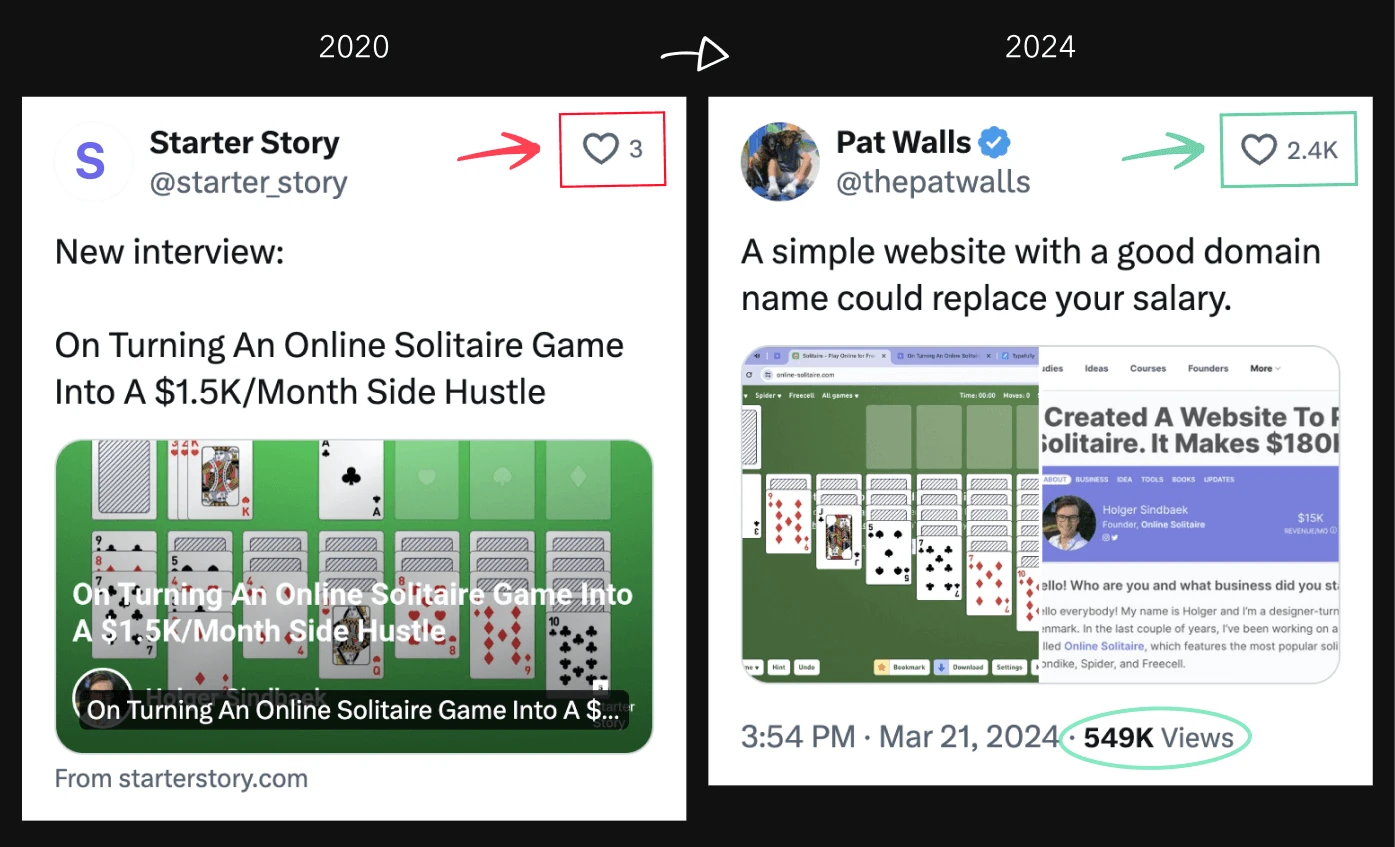
An interview has become an invitation to imagine a different life.
It is tempting to declare the second sentence a formula for virality. Before we do, a few things deserve a place beside the like count: the posts came from different accounts, appeared in different years, used different images, and presented different income figures. We have a screenshot, not a controlled experiment. The apparent winner does not tell us what would have happened if only the wording had changed.
It does, however, give us a useful place to begin.
This first article proposes the attainable opportunity: connect a desire your audience recognizes to a possibility they can believe, express it clearly, and give them something worth passing on. The ingredients have different levels of research support. Their combination is a hypothesis to test.
The wording changed. So did the package.
Read the captured posts as two different publishing situations, rather than a matched experiment.Metrics are transcribed from the supplied Vault screenshot and were not independently verified. No matched exposure denominator, observation period, or sharing tree is available.
The story acquires a second subject: the reader
The earlier post answers a publishing question: what is the new interview about? It is specific and useful to someone already interested in online games or small internet businesses. Everyone else must work out why it matters.
The later sentence offers a personal reference point: “your salary.” The subject is still a website, but the consequence belongs to the person reading. “Simple” makes the vehicle seem understandable. “Good domain name” supplies a concrete detail. “Could” leaves room for possibility and an unanswered question about how it works.
That is an interpretation of the language. It is not a measurement of the audience's thoughts. Some readers may have felt hopeful. Others may have liked the post because it was surprising, doubtful, or funny. A heart icon is a poor interview transcript.
The practical insight is to make the consequence of a story visible. What could someone understand, decide, avoid, or attempt after reading it? A hook earns its place when it makes that value apparent.
Academic hooks also have to establish a reason to care
A research paper faces a related problem. Its subject may be important, yet the reader still needs to understand what is at stake.
Harvard's writing guidance explains that an introduction can create interest through a consequential question. A dramatic fact or opening flourish is optional. The CARS model associated with John Swales describes establishing a research territory, identifying a niche, and making a contribution within it. The UMass account of the model shows how that niche can be a gap, a question, or an extension of existing work.
For a social post, the useful parallel is to locate something the audience cares about, make an unresolved issue apparent, and offer a reason to continue. The standards differ: a scholarly introduction must locate its contribution accurately within a field. It is not a template for social-media performance.
A hook can be a sentence, an opening passage, or a problem that becomes more interesting as the writer explains it. What matters is the connection it establishes between the material and the reader's reason to pay attention.
Desire becomes useful when it becomes specific
The Vault caption interprets the salary sentence as an appeal to wealth. That is plausible, but “wealth” can conceal several concerns. One reader wants financial security. Another wants flexible work. Another wants the satisfaction of building a useful product.
These are different audiences, even if they all notice the same number. Schwartz's account of human values describes recurring patterns across societies alongside substantial differences in people's priorities. It gives us no basis for treating wealth as everyone's leading desire.
“Write for the everyday person” works as advice to make the point understandable. It does not remove the need to choose whom the piece serves.
For a developer, the interesting possibility may be a small product that earns revenue. For a business owner, it may be a service that attracts demand without a large team. For someone seeking flexible work, it may be control over their schedule. The same case can support several appeals, but the evidence must support the particular one the writer chooses.
Start with a recognizable concern. Then check it against the questions people ask, the trade-offs they describe, and the decisions they actually make.
A believable possibility needs a route
Wanting an outcome and expecting to achieve it are separate judgments. Situated expectancy-value theory distinguishes expected success, the value of an activity, and its costs. The theory comes largely from achievement and education research. Applying it to opportunity content is an analogy, not direct proof of a sharing effect.
It nevertheless helps us ask a better question about the word “simple.” Does it make the route easier to understand, or does it make the necessary work disappear?
The 2020 founder interview describes design and development experience, product decisions, domain changes, and search traffic. A later update discusses time-consuming marketing and outreach. The business may look simple from the outside. Running it still takes work.
The pages also require careful reading. The original interview body reports about $1,500 per month, while its current business metadata shows $15,000. The later account reports about $15,000 in monthly revenue. These are self-reported business figures, and revenue is not take-home salary.
Credible attainability means explaining a plausible route and the conditions under which the outcome occurred. It may involve a mechanism, a demonstrated process, or relevant experience. A successful case establishes that something happened. It does not establish how likely another reader is to reproduce it.
For this proposed formula, the promise should survive the explanation that follows it. Otherwise, the hook creates an expectation the article cannot repay.
Clarity can leave a worthwhile question open
Research offers stronger evidence for clear expression than a successful-post anecdote does. Shulman, Markowitz, and Rogers analyzed more than 30,000 headline experiments from The Washington Post and Upworthy, alongside follow-up studies. Readers generally selected simpler headlines more often.
The main field outcome was clicking. Headline variants also changed packages of words, so the analysis does not isolate every linguistic feature independently. It supports understandable language without proving that the shortest sentence will be the most widely shared.
Clarity does not require giving away the entire explanation. The salary sentence makes the outcome comprehensible while leaving the business mechanism unresolved. A reader can understand what is being offered and still want to know how it works.
Loewenstein's information-gap theory connects curiosity with a perceived gap in knowledge. The gap must matter to the person encountering it. Withholding information about something they do not care about is simply withholding information.
A 2025 registered report by Aubin Le Quéré and Matias examined 8,977 headline experiments. Adding concrete information helped comparatively vague headlines and could hurt already detailed ones. There was no general rule that more disclosure, or less disclosure, always produced more clicks.
Make the subject and stakes clear. Leave an explanation worth discovering. Keep any condition that materially changes the promise visible enough for readers to form an accurate expectation.
Sharing brings another person into the decision
Someone can read a story, enjoy it, and never pass it on. The piece may have answered a private question. It may be irrelevant to their friends. Or they may find it interesting without wanting their name attached to its claims.
Sharing therefore needs its own explanation.
Cosme and colleagues examined self and social relevance across six studies involving 3,727 US adults. Their work included a framing experiment that increased sharing intentions by making relevance more salient. It also distinguishes broadcasting to an audience from sending something to a particular person. Intentions are not observed viral cascades, but the distinction is useful for writers.
The reader may want to know how the business works. Their friend may need a realistic example of a small product, an explanation of search traffic, or something concrete to discuss before starting a project. A story becomes easier to recommend when it offers value in that second person's situation.
Scholz and colleagues' model of information virality also treats sharing as a value judgment involving consequences for oneself and others. Its population findings are correlational. They support a plausible account of sharing without supplying a switch a writer can flip.
For an opportunity story, the shareable value might be a clear account of how revenue is earned, what changed over time, or which costs a new founder should investigate. These are proposed editorial applications, and their effects need testing.
Before adding “share this,” answer a more useful question: who would the reader send it to, and what would that person gain?
Four properties. A reason to continue and a reason to share.
Each property answers a different reader question; evidence for the complete combination remains open.An editorial synthesis of the cited relevance, motivation, headline, and sharing research. Credible attainability has indirect support; sharing-intention findings do not establish viral cascades.
Excitement and credibility shape different decisions
Berger and Milkman's research found that emotional activation helped explain online transmission, alongside practical usefulness and surprise. A hopeful possibility may energize someone enough to act. The salary screenshot cannot establish whether that happened here.
Attention can also come with a reason not to share. A person may click an exaggerated claim to investigate it, then decline to recommend it. Mukherjee, Dutta, and De Bruyn report experimental evidence consistent with perceived manipulation reducing source evaluation and sharing intentions. Their observational study of 19,386 articles from 27 publishers also found less sharing for clickbait on average.
An interesting opening gets examined. A credible explanation gives the reader something they can stand behind. For creators and businesses seeking lasting trust, both judgments matter.
Large reach does not reveal how a post spread
A large account can expose a post to many people directly. The post can also travel through successive rounds of sharing. Those paths can produce similar totals.
Goel and colleagues distinguish the size of a diffusion event from its structural virality: how information travels through the sharing tree. A view count cannot reveal that structure.
The same total can conceal different paths.
A broadcast and a sharing chain can reach equally many people while having very different structures.Conceptual illustration informed by Goel and colleagues. Neither tree represents the featured posts; node counts are chosen to hold the total constant, not to report a study result.
The 549K views in the Vault image show reported reach. They do not tell us how much came from the account's audience, recommendations, direct sharing, or later generations of recipients. Nor are likes, replies, saves, sends, and purchases interchangeable measures of success.
An argument may generate comments. A guide may generate saves. A headline may generate clicks. When investigating a formula for sharing, measure sharing, and then examine what happens to the people it reaches.
Turn the formula into a test
The proposed combination is:
Recognizable desire + credible attainability + clear expression + a reason to share.
The plus signs identify ingredients. They are not measured weights, and the complete combination has not been validated as a law of virality. Curiosity can support the opening; distribution affects whether the content reaches further audiences.
To test the opportunity frame, choose a real case whose facts you can support. Compare a descriptive introduction with one that makes a personally relevant opportunity apparent. Keep the underlying claims, source, image, placement, and observation period comparable. Otherwise, the result describes two different packages without explaining which change mattered.
Test recipient usefulness separately. Compare the same facts presented plainly with those facts organized around something a specific recipient could use. Keep both versions readable and credible. This helps distinguish the attraction of the opening from the value of passing the piece on.
Where possible, assign versions randomly. Measure completed shares per assigned exposure, including people who did not click. If the platform only reports share-button clicks, label them as a proxy. Check comprehension and credibility alongside action counts, and repeat the comparison across several cases.
For creators, the test can reveal whether an audience sees something worth recommending. For marketers and business owners, the next question is whether those recommendations bring useful attention: informed readers, relevant enquiries, or customers who understood the promise.
The first post in the Vault announces something that happened to a founder. The later post suggests something that might matter to the reader. That is a meaningful editorial move. The next move is to make the explanation useful enough that the reader can see someone else in it, too.
Summary
Treat the attainable opportunity as a hypothesis: a clear, believable possibility can earn attention, while useful relevance to another person gives the reader a reason to share.
- Choose a specific audience and identify the consequence that makes the story matter to them.
- Explain the route, required work, and limits that make the opportunity credible.
- Make the proposition clear while leaving a worthwhile explanation to discover.
- Identify a recipient and what that person would gain from receiving the piece.
- Compare matched versions with random assignment where possible; measure completed shares, comprehension, and credibility.
- Examine how the message reaches further audiences before calling its success viral.